
Chronology
The Last Years at Arcetri
1634-1642
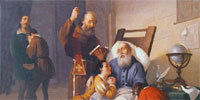

Galileo's
last years at Arcetri were sad ones. In 1634 he was bereft of the support of
his beloved daughter Suor Maria Celeste, who died at the age of only
thirty-four. In January 1639 he was allowed, due to his precarious state of
health, to offer hospitality in his home to the young Vincenzo Viviani, and
still later to Evangelista Torricelli.
In
1638, when he had now become totally blind, his text Discorsi e dimostrazioni intorno a due nuove scienze [Discourses and Demonstrations on Two New Sciences] (Leiden, 1638) was published in Leiden. This work
inaugurated the new science of the resistance of material bodies. For the first
time, precise methods were proposed for theoretically predicting the breaking
point of bodies subjected to traction or to which weights had been applied. It
also made major contributions to the field of statics, with innovative analyses
of the problems of equilibrium and the operation of simple machines. The most
significant contribution of this work may be found in its first public
presentation, which furnished basic laws on the natural motions discovered by
Galileo. Lastly, the Pisan scientist stated here the laws of pendular motion
and the parabolic trajectory of projectiles.
At
Arcetri Galileo ended his days. His last moments were described by Viviani as
follows:
"Overcome
by long fever and palpitations of the heart, after two months of illness that
little by little consumed his spirits, on Wednesday the 8th of January of the
year 1642, at the fourth hour of the night, aged seventy-seven years, ten
months and twenty days, with philosophy and Christian constancy he rendered his
soul to his Creator, this soul being sent, as we may be glad to believe, to enjoy and admire again more
closely those eternal and immutable marvels that, by means of fragile artifice,
with such great avidity and impatience it had managed to bring closer to the
eyes of us mortals."